How to Set Up Your Backyard for Beginners
New to backyard projects? Here's how to set up your outdoor space step by step, from furniture and shade to pools, grills and robot mowers.
By TheYardForge — outdoor and garden gear, analyzed honestly for real backyards
If you're here, you're probably staring at a blank yard wondering where to even start. The short answer is this: start with the basics that match how you actually want to use the space, not some dream Pinterest board. Most beginners set up a backyard successfully by tackling three core zones in order, somewhere comfortable to sit, somewhere to cook or gather, and somewhere for the kids or pets to play. Add shade early, because without it nobody uses the space in summer. Then layer in the fun stuff like a pool, better lawn care or lighting once the bones are in place. The options feel overwhelming at first, that's normal. This guide walks you through the process in the order that makes the most sense, with honest advice on what to buy, what to skip, and where to call in help.
Quick note: some links in this article are Amazon affiliate links, they support the blog at no extra cost to you.
Figure Out How You'll Actually Use the Space
Before you buy a single chair or fire up a drill, walk your yard with a notepad and ask yourself one question: what do we need this space to do? A young family needs a lawn the kids can wreck and a shaded spot for a kiddie pool. A couple who loves hosting needs seating for eight and a grill within arm's reach of the kitchen. A single person working from home might want a quiet corner with a parasol and a side table for a laptop.
Most beginners skip this step and buy what looks good, then realize six months later they've got a fancy sectional they never sit on because it's always in full sun. So be honest. Do you cook outdoors more than twice a summer? Do the kids actually play outside, or do they stay glued to screens? Will you realistically mow every week, or does a robot mower make more sense?
Write down your actual use cases, then rank them. The top two or three drive your first purchases. Everything else waits.
Start with Seating and Shade
The backbone of any backyard is somewhere comfortable to sit, and unless your yard faces north or lives under old trees, you need shade. Without it, the space sits empty from May to September.
For seating, most beginners do best with a simple resin or rattan set that handles weather without drama. Keter garden furniture offers solid, low-maintenance options that won't rot or rust. Look for a table and four to six chairs if you host occasionally, or a smaller bistro set if it's mostly just you and a partner. Avoid cushions that need to come inside every night unless you genuinely enjoy that routine, because most people stop doing it by week three.
For shade, a quality cantilever parasol gives you the most flexibility. You can angle it as the sun moves, and it doesn't eat up table space with a center pole. Outsunny garden parasols come in multiple sizes and handle wind better than budget models. Measure your seating area first, a 10-foot canopy covers a four-person table comfortably, an 11- or 13-foot works for six to eight. Skip the parasol if you want the whole corner covered: a permanent shade sail or pergola makes more sense, but that's a bigger commitment and usually waits until year two.
Pros of starting with furniture and shade:
- Instant usability, you're sitting outside the same weekend
- Low cost compared to pools or permanent structures
- Easy to rearrange if you change your mind
Cons and who should skip it:
- Furniture alone doesn't make the yard interesting if you've got active kids
- Skip the big dining set if you genuinely never eat outside
Add a Grill or Outdoor Cooking Setup
If you cook outdoors more than a handful of times each summer, a decent grill pays for itself in use and becomes the center of most gatherings. For beginners, a mid-range gas grill offers the best balance of ease and results. Charcoal tastes great but takes practice and patience. Pellet grills cost more and need electricity. Gas grills light instantly and hold steady temps, which matters when you're still learning.
Weber grills are the benchmark here, the Spirit line is the sweet spot for most backyards. Look for at least two burners so you can set up direct and indirect zones, and check that the frame and grates are solid. Avoid the cheapest models with thin steel that warps after one season.
Place the grill on a level surface, at least ten feet from the house and any overhanging branches or fabric shade. You'll want it close enough to the kitchen that you're not hiking across the yard with raw chicken, but far enough that smoke doesn't pour into the living room. A small prep table or cart next to the grill makes life easier, you can stage plates and tools without running back inside every two minutes.
One thing to note: if you're hooking up a natural gas line instead of using propane tanks, that's a job for a professional. Don't attempt gas plumbing yourself.
Set Up a Pool if It Fits Your Space and Budget
An above-ground pool transforms a backyard for families, but it's a real commitment of space, setup time, and weekly maintenance. If you've got kids or you love cooling off in summer, it's often the best money you'll spend. If you rarely use it, it becomes an expensive planter full of algae.
For beginners, a steel-frame pool strikes the best balance between durability and price. Bestway pools and Intex pools both offer solid options, Bestway frames tend to hold up a bit better over multiple seasons, Intex wins on availability and bundle deals. Size depends on your yard, but for a family of four, a 12-foot round or 10x20-foot rectangular pool gives everyone room to actually swim rather than just stand.
Here's what most beginners underestimate: the filtration system matters as much as the pool itself. A cartridge filter pump keeps the water clear, and you'll need to run it several hours a day. The pump that comes in the box usually works, but confirm it matches the pool size according to the manufacturer's specs.
Pool setup checklist:
- Pick a flat, level spot away from trees (roots and falling leaves are your enemy)
- Lay down a ground cloth to protect the liner from punctures
- Assemble the frame according to the instructions, with at least two people
- Fill slowly and check for level as you go
- Connect the filter pump per the manual, if you need mains power run to the pool, hire a qualified electrician
- Balance the water chemistry using the exact products and dosages on the manufacturer's label or with a pool professional
You'll also want a pool cover to keep debris out overnight and a skimmer net for daily cleanup. Budget about 30 minutes a week for basic maintenance once the pool is running.
Tackle the Lawn with Realistic Expectations
A great lawn takes consistent effort, and most beginners either try to do too much or give up entirely after the first weedy summer. The middle path works best: aim for green and healthy, not golf-course perfect.
If you're starting from scratch or fixing a neglected lawn, early fall or early spring are the best times to seed or lay sod. Mow regularly once the grass is established, weekly in the growing season, and never cut more than one-third of the blade height at a time. Most grasses do best at about 2.5 to 3 inches tall.
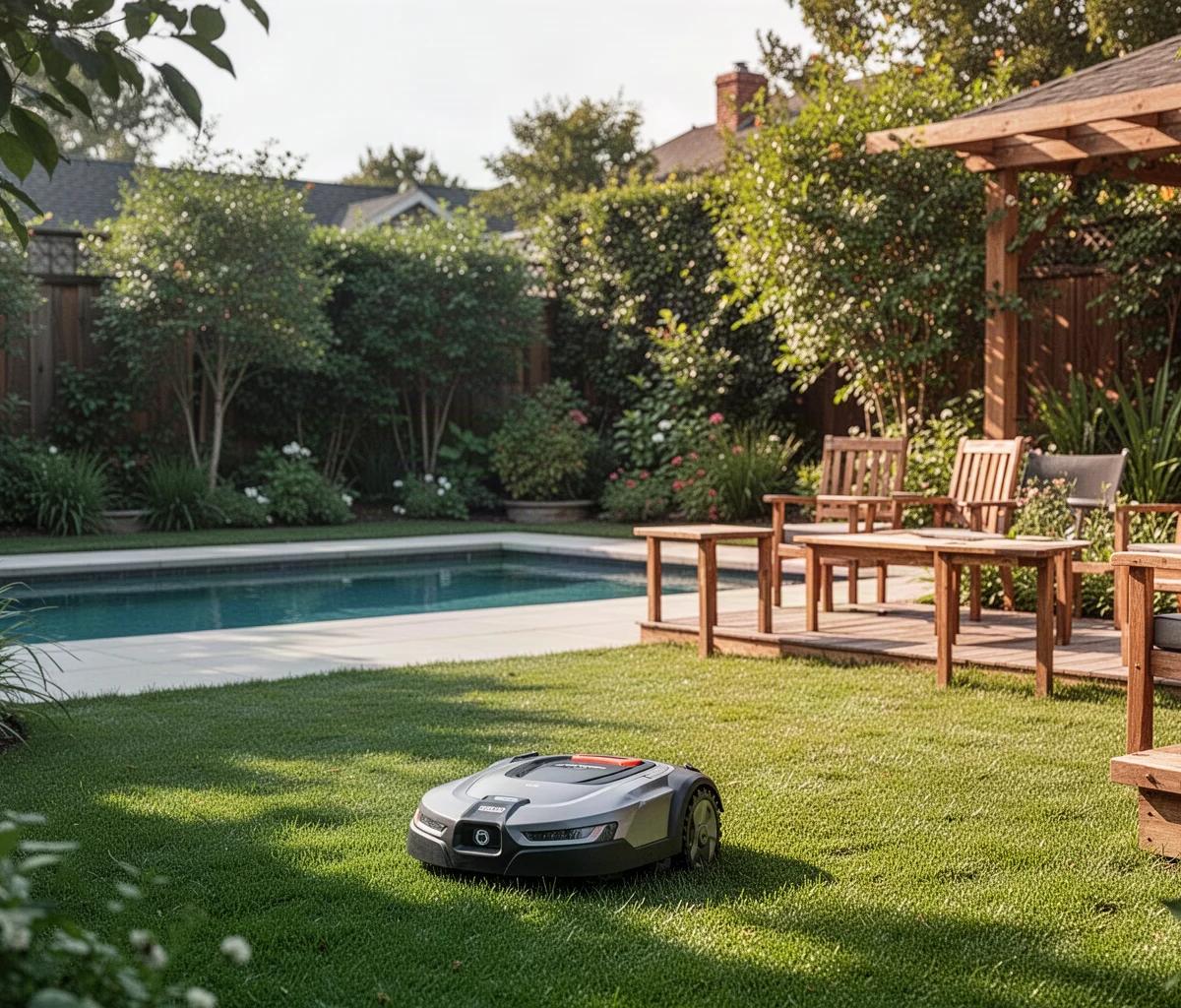
For mowing, a traditional push mower is fine for small to mid-size yards if you don't mind the weekly routine. But if you've got a quarter acre or more, or if your weekends are already packed, a robot mower changes the game. Worx Landroid and Husqvarna Automower are the two most common brands for beginners, Worx models are more affordable and handle slopes up to 20 degrees, Husqvarna models cost more but are quieter and work on steeper terrain. The Segway Navimow is another solid option, especially if you want to avoid burying a boundary wire. Check the specs for your yard size and slope before you buy, and confirm the exact coverage area and max incline on the product page.
Water deeply once or twice a week rather than a shallow sprinkle every day, deep watering encourages deeper roots and a healthier lawn. If you see brown patches, check for grubs or compacted soil before you assume it's a watering problem.
Skip the robot mower if:
- Your yard is under 1,000 square feet (a push mower is faster)
- You've got a lot of obstacles or tight corners the robot will struggle with
- You genuinely enjoy the meditative rhythm of push mowing
Layer in the Details Over Time
Once the big pieces are in place, seating, shade, cooking, maybe a pool, a decent lawn, then you get to the fun details that make the space feel like yours. String lights add instant atmosphere and cost almost nothing. A fire pit or chiminea extends the season into fall. Raised garden beds or a small greenhouse give you somewhere to grow herbs or tomatoes. Palram greenhouses are beginner-friendly and available in multiple sizes, starting around 4x6 feet.
For tools, start with the basics: a good hose, a sturdy rake, a hand trowel, pruners, and a wheelbarrow if your yard is big enough to justify one. Fiskars garden tools and Gardena products both hold up well and don't cost a fortune. Add specialty tools only as you actually need them, most beginners collect a shed full of gadgets they use once.
| Detail Item | Best For | Skip If |
|---|---|---|
| String lights | Instant evening atmosphere | You never use the space after dark |
| Fire pit | Extending the season into fall | Fire bans in your area |
| Raised garden beds | Growing food in poor soil | You've never kept a houseplant alive |
| Pressure washer | Cleaning decks, furniture, siding | Small yard, minimal hardscaping |
| Hose reel | Keeping the yard tidy | Very short hose, no storage issues |
A pressure washer is overkill for most beginners, but if you've got a deck, patio or vinyl siding, it makes spring cleaning dramatically easier. Kärcher pressure washers are the go-to for residential use. Just start with low pressure and work your way up, you can strip paint or gouge wood if you're careless.
Related reading
- Getting Your Patio Ready for Summer
- DIY PVC Greenhouse Ideas for Cheap Backyard Setup
- How to Maintain a Pool for Beginners
FAQ
How much does it cost to set up a basic backyard?
A functional backyard with seating, shade and a grill runs roughly $800 to $1,500 depending on the brands you choose. Add a mid-size above-ground pool and you're closer to $2,500 to $3,500 all in. A robot mower adds another $600 to $1,200 depending on the model. Check current prices on Amazon, they shift seasonally.
Can I set up a backyard myself or do I need to hire help?
Most backyard projects are beginner-friendly DIY, assembling furniture, setting up a pool frame, installing a parasol or a robot mower boundary. But some jobs require a professional: pool electrical and plumbing work should be handled by a qualified electrician or pool installer, gas grill hookups need a licensed plumber or gas fitter, and any structural projects like pergolas or retaining walls should be done by someone who understands load and drainage. When in doubt, hire it out.
What should I buy first when starting from scratch?
Start with seating and shade, because without those two pieces nobody uses the space. Once you can sit comfortably outside, add the cooking or play element that matches your family's actual routine. Everything else layers in over time.
How do I maintain a pool as a beginner?
Run the filter pump several hours a day, skim debris daily, vacuum the bottom weekly, and balance the water chemistry using the exact products and dosages on the manufacturer's label or with guidance from a pool professional. Never guess on chemical amounts. Most beginners overestimate how hard it is, the routine becomes automatic after a few weeks.
Do I need a professional to install a robot mower?
No, most robot mowers are designed for DIY setup. You'll lay a boundary wire or set virtual boundaries depending on the model, position the charging station, and run the initial mapping. The manual walks you through it step by step. If you're genuinely not comfortable with basic outdoor tech, some dealers offer installation services.
What's the biggest mistake beginners make with backyards?
Buying everything at once without testing how they actually use the space. Start with the basics, live with them for a season, then add more. You'll save money and end up with a yard that fits your life rather than someone else's idea of the perfect setup.
Should I focus on the lawn or the seating area first?
Seating first. A perfect lawn with nowhere comfortable to sit means nobody enjoys the yard. You can improve the lawn gradually over a season or two, but you need seating and shade from day one.
How do I choose between a gas grill and a charcoal grill?
Gas grills are easier for beginners, instant heat, steady temps, less cleanup. Charcoal grills give you better flavor if you're willing to learn fire management and spend the extra time. If you grill more than once a week, gas wins on convenience.
Wrapping It Up
Setting up a backyard from scratch feels like a massive project, but if you take it one zone at a time and focus on how you'll genuinely use the space, it comes together faster than you think. Start with comfort and shade, add the cooking or play elements that match your routine, and layer in the details as you go. Most of all, be patient with yourself, the best backyards evolve over a season or two, they're not finished in a weekend.